(716) 247-5254 admin@wmarnis.com
To Shoe or Not to Shoe? A Martial Artist’s Perspective

To Shoe or Not to Shoe? A Martial Artist’s Perspective

To Shoe or Not to Shoe? A Martial Artist’s Perspective

That’s the question I’ve been asked a lot lately—and honestly, it still baffles me. For some reason, people assume you’re either less of a martial artist or being unreasonable if you wear mat shoes on the training floor. But let’s call it what it is: mat shoes.

At my school, we actually wear sneakers for better arch support. The only rule is simple—they must be dedicated indoor shoes. No exceptions. Why? Because we don’t want dirt, debris, or worse—biological hazards—ending up on the mats. People roll on those mats, and safety is non-negotiable.

Martial Arts and Shoes Go Way Back

Plenty of martial arts train with shoes. Look at Chinese Kung Fu—it’s common to see practitioners wearing them. In my own art, Filipino Martial Arts, training wasn’t traditionally done in dojos. Why? Because most communities couldn’t afford them. Practice happened in the streets or in parks—and let’s be real, barefoot training in a park isn’t the smartest idea. Sharp rocks, glass, and plenty of other things you don’t want in your foot are everywhere.

And let’s face it: in a real-world encounter, are you really going to take your shoes off first? Of course not. So, wouldn’t it make sense to at least sometimes train with footwear?

Balancing Realism with Safety

Now, don’t get me wrong—there are times when shoes don’t belong on the mat. For example, when we spar with punches and kicks, padded foot gear is required to keep everyone safe. And when we grapple on the ground, it’s barefoot only—you don’t want someone shoving a shoe into your ribs or face. So yes, I still train barefoot, probably more often than not. But I also believe in balance.

For those of us who attend or teach seminars in conference centers or hotel ballrooms, the hygiene factor comes into play too. I’ve been on enough questionable carpets to know I don’t want to walk around barefoot on them. And in a weapon-centric system like mine, footwear offers one more layer of protection. If you’ve ever had a stick or training knife dropped on your bare foot, you know the difference even a thin shoe can make.

Why Barefoot Training Exists

So, why do so many arts insist on bare feet? Part of it is cultural. Karate, Taekwondo, and similar systems evolved in environments where shoes were often removed indoors for tradition and respect. We’ve adopted those systems here in the States—but the environment isn’t always the same. Adaptation is part of growth.

My Perspective

At the end of the day, shoes or no shoes doesn’t change the art itself. The techniques are the techniques. But as an advocate for realistic training, especially in our adult program, I see shoes as bringing us one step closer to the real-world conditions we might face.

That’s my stance. Train safe, train smart.

Respectfully,
Datu Tim Hartman
World Modern Arnis Alliance

Was Modern Arnis Created to Defeat Balintawak?

Was Modern Arnis Created to Defeat Balintawak?

Was Modern Arnis Created to Defeat Balintawak?
I’ve heard this rumor for years, and it’s simply not true. Before making any claims about either art, you really need to have trained—or at least seriously studied—both. Modern Arnis and Balintawak share a deep relationship. I know this firsthand, because Professor Remy Presas personally opened the door for me to train with the late Grandmaster Ted Buot, the designated successor of Balintawak founder Anciong Bacon.

Professor Presas himself wasn’t just familiar with Balintawak—he was one of its top fighters. During his time in the club, the clear number one was Anciong, followed by Delfin López and Professor Presas. But here’s the first thing to understand: there is a difference between Remy Presas’s personal fighting style and the martial system he created.

The Purpose of Modern Arnis
Modern Arnis was not designed to defeat Balintawak, or any system for that matter. It was designed primarily as a self-defense system, created to meet the needs of ordinary Filipinos. The art focuses on teaching people how to protect themselves against the most likely threats—untrained attackers using whatever weapons they could grab, be it a stick, a knife, or even a brick.

Could Modern Arnis be used as a fighting art? Absolutely. I’ve proven it myself in stick fighting, open sparring, and international tournaments. My students have as well—even to the point of becoming cage fighting champions, like Primo Luciano back in the early EFC days. But the foundation of the art is, and always was, self-defense.

The Relationship Between the Arts
Balintawak and Modern Arnis are “cousins.” Both can counter each other, but to understand that, you have to train in both. Neither side has the other’s playbook, so without exposure, you will be caught off guard. That’s exactly why I value my background in both systems—I trained as a top student of Professor Presas, and later as a senior student under Grandmaster Ted Buot. I’ve seen how the two interact, how each can counter the other, and how they ultimately complement one another.

But knowing how to play that chess match doesn’t mean one art was created to beat the other. That’s a myth.

Respect and Brotherhood
If Professor Presas had an issue with the Balintawak community, he wouldn’t have maintained such strong relationships with its leaders and players. In fact, many of them respected him deeply. A perfect example is his friendship with Grandmaster Bobby Taboada—so close that Remy even bought the engagement ring Bobby used to propose to his wife. That’s not the behavior of someone trying to undermine another art.

The truth is simple: Professor Presas had no problem with Balintawak. He respected it, trained in it, and built relationships with its masters. Modern Arnis was influenced by Balintawak, yes—but it was never created to defeat it.

Final Thoughts
I’m in a unique position to speak on this topic, having been asked by Professor Presas himself to carry on his art, while also being a senior student of Grandmaster Buot in Balintawak. I can say with confidence: these arts are part of the same family.

Modern Arnis is not a derivative of Balintawak—it is an art in its own right, influenced by it but with a different mission. One focuses on self-defense for the masses, the other on close-quarters fighting refinement. At higher levels of Modern Arnis, you’ll see Balintawak’s fingerprints. But at the end of the day, both arts stand as cousins in the same family of Eskrima.

So let’s stop the nonsense and set the record straight. Modern Arnis was never about defeating Balintawak. It was about empowering people to defend themselves, while honoring the traditions and influences of the arts that shaped it.

Respectfully,
Datu Tim Hartman
Remy Presas Modern Arnis
Bacon–Buot Balintawak Eskrima

#balintawak #modernarnis #filipinomartialarts #martialarts

Presas Arnis vs. Presas Legacy – Understanding the Difference

Presas Arnis vs. Presas Legacy – Understanding the Difference

Presas Arnis vs. Presas Legacy – Understanding the Difference

I’m often asked about the difference between Presas Arnis, which I teach, and the Presas Legacy organization in the Philippines. The explanation is simple: I represent the family systems directly.

I was fortunate to have a relationship with all three Presas brothers. I studied under Grandmaster Remy until his passing in 2001 and helped the brothers reconnect before their time together was cut short. During that time, I also trained in Kombatan under Great Grandmaster Ernesto, who promoted me to 9th degree and Grandmaster in 2007.

When I taught seminars, I combined material from both brothers. To avoid debates about which version was “correct,” I used the name Presas Arnis as an umbrella. In 2012, shortly after Ernesto’s passing, I officially launched the Presas Arnis brand, while continuing to certify students in both Modern Arnis and Kombatan.

By 2018, at the Kombatan Super Camp in Finland, we were already using the Presas Arnis name prominently. Others later followed this trend. Eventually, the Presas Legacy organization was formed in the Philippines to umbrella all Presas family systems for those without a direct connection to the brothers.

Am I part of that group? No. I have a direct relationship with the Presas brothers and still maintain a close friendship with Roberto, the surviving brother. My teaching record stands on its own, with seminars across many states and countries each year.

I understand why some might join an umbrella organization for community or guidance. Everyone has their own path. For me, Presas Arnis stands on its own, separate from the Presas Legacy group.

I hope this clarifies things for everyone.

Respectfully,
Tim Hartman
Datu – GM Presas Family Arnis
CEO, World Modern Arnis Alliance

#modernarnis #filipinomartialarts #selfdefense

Why People Said I “Left” Modern Arnis – And Why They’re Wrong

Why People Said I “Left” Modern Arnis – And Why They’re Wrong

Why People Said I “Left” Modern Arnis – And Why They’re Wrong

For years, I’ve heard the same rumor: “Tim left Modern Arnis.”

Some even claim it happened while Professor was still alive — years before his diagnosis. And I’ve always wondered… where on earth does that come from?

During that time, my students were passing black belt tests. Professor had me teaching not just the forms, but other key aspects of the art. People sought me out specifically to prepare for their own black belt tests. That doesn’t sound like leaving the art to me.

But then came the ’99 Michigan camp. I was talking with Randy Shea when he suddenly said, “You don’t even do Modern Arnis anymore.” It caught me completely off guard. I had no idea how to unpack that statement.

When I thought about it, I realized the opposite was true — I was doing a deeper dive into Modern Arnis than most. The difference was that I approached it as a standalone system, not just “the art within your art.”

It started with language. Professor Presas often used English names for techniques. Nothing wrong with that, but I wanted to connect more closely to the art’s Filipino roots. If I was teaching Filipino martial arts, I wanted Filipino terminology whenever possible.

Take the “six-count drill,” for example — more authentically called sumbrada. We also had a ten-count version. So when I taught it, I’d say: “We’re going to do sumbrada drill, six-count version.” Still in line with how Professor referred to it, but with the original term front and center.

Another example: gunting, which means “to scissor.” Many know it as a limb destruction. If you look at the opening of the second form, you see limb destructions on both the left and right sides. If you only did Modern Arnis as cross-training, you might miss that connection. As my primary system, I had the opportunity — and the reason — to go deeper.

That ’99 camp was also the year Professor called me Datu. At the 2000 Michigan camp, I tested for my 6th degree. Professor announced it as the highest black belt test in the United States — the highest in over 17 years — and told me, “Now you’re a Datu in their eyes, because you were already a Datu in mine.”

Yet after his passing, the same rumor persisted. People pointed to the fact that I trained in Kuntaw, Sikaran, Balintawak, and other Filipino systems as “proof” I’d left the art. But here’s the thing — I was doing that while Professor was still alive. And he supported it.

Modern Arnis is a hybrid art. Professor himself told me about the systems that influenced it — Kuntaw, Sikaran, Balintawak, and more. He personally introduced me to Balintawak Grandmaster Ted Buot in Detroit, where I got direct access to one of Modern Arnis’s biggest influences. I trained with Wally Jay, whose Small Circle Jujitsu also shaped our curriculum.

I didn’t study these systems to “run away” from Modern Arnis — I studied them to understand it more completely. Unfortunately, jealousy and insecurity make some people rewrite the story.

Today, I teach a Presas Arnis curriculum — an umbrella that includes the systems I’ve learned. But when it’s time to teach Modern Arnis, Balintawak, Kuntaw, or Sikaran, I can separate them and do each justice. I know exactly what belongs to each art.

Here’s my philosophy: you can’t know where you’re going if you don’t know where you’ve come from. Innovation is important, but it has to be built on a solid foundation. As I tell my students — algebra, calculus, and trigonometry are just advanced math, but they’re impossible without mastering basic math first. Advanced techniques are simply sophisticated basics.

So, did I “leave” Modern Arnis? No. I went deeper than most were willing to go. You can decide for yourself — but I know the truth.

Respectfully,
GM Datu Tim Hartman
CEO, World Modern Arnis Alliance

#fma #filipinomartialarts #martialarts #selfdefense #modernarnis


What’s in a Logo? The Meaning Behind Modern Arnis & World Modern Arnis Symbols

What’s in a Logo? The Meaning Behind Modern Arnis & World Modern Arnis Symbols

 What’s in a Logo? The Meaning Behind Modern Arnis & World Modern Arnis Symbols

Over the years, I’ve had a lot of conversations with people about our logos—both the Modern Arnis emblem and the World Modern Arnis logo—and I’m always surprised by how many folks don’t know what they actually mean. So, I figured it’s time to break it down and share the story behind the symbols we wear with pride.

Modern Arnis Logo

The Modern Arnis emblem is packed with meaning. The sun, along with the red and blue, comes straight from the Filipino flag, honoring the art’s cultural roots. That connection to the Philippines is something we always strive to respect and preserve.

The pattern of arms, sticks, and swords isn’t just a cool design—it represents the sinawali or “weaving” flow of movement we practice. It’s also a visual of our philosophy: structure, motion, and unity. The interlocking arms stand for the unity among practitioners, and the square formed within the circle reflects the two lines of attack: linear and circular.

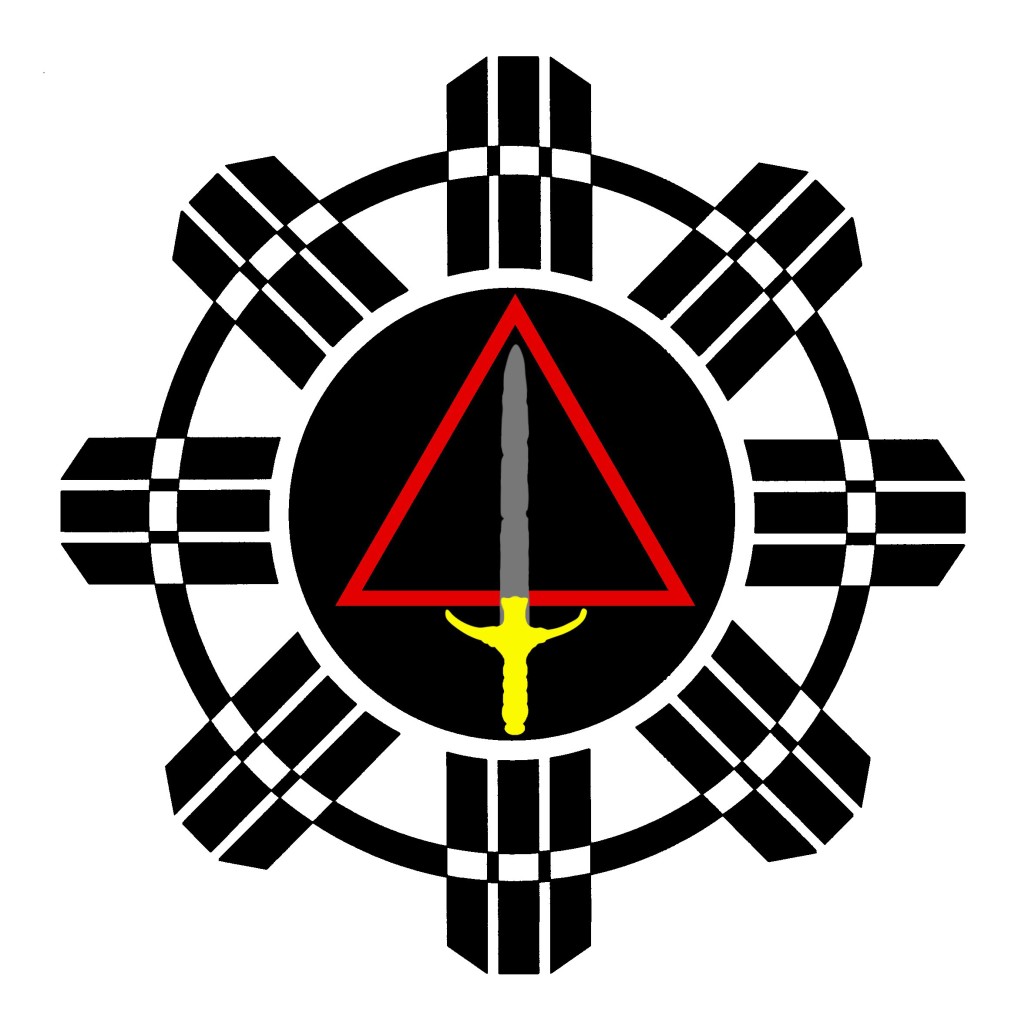
World Modern Arnis Logo

The sun here also pays tribute to the Filipino flag and to Professor Remy Presas, the founder of Modern Arnis. The eight rays of the sun represent the eight angles of attack we teach.

The black in the logo is a sign of mourning and respect for the Presas brothers—Remy, Ernesto, and Roberto—whose contributions shaped the art as we know it.

The triangle holds even more meaning. It represents our 3 x 3 Matrix:

  • The Presas brothers: Remy, Ernesto, and Roberto
  • The three aspects: Martial Art, Martial Sport, and Martial Combat
  • The three pillars: Fitness, Form, and Function

The sword in the center? That’s all about the warrior spirit—and it also acknowledges the non-Filipino influences that have helped Modern Arnis evolve.

I hope this gives you a better sense of what our logos stand for—and why we wear them with pride. If you have a logo of your own, I’d love to hear the story behind it. Whether it’s packed with symbolism or just an awesome design, there’s always something to be said about how we choose to represent ourselves and our journey.

Respectfully,
Datu Tim Hartman
Grand Master of Presas Arnis
CEO, World Modern Arnis
“The FMA Ambassador”

#ModernArnis #WorldModernArnis #FMA #FilipinoMartialArts #PresasLegacy #Arnis #MartialArtsLogos #Sinawali #FilipinoCulture #StickFighting #MartialArtsPhilosophy #WMAA #DatuHartman #FMACommunity