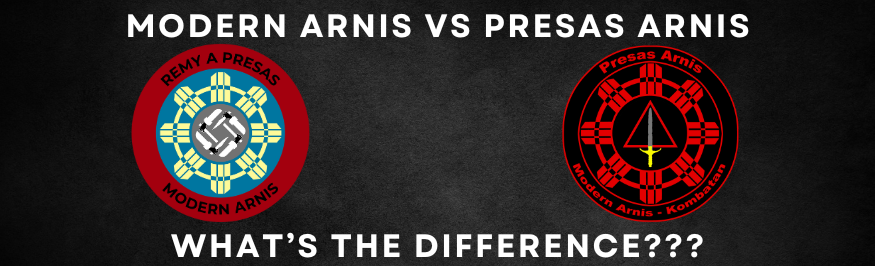
I get this question all the time—what’s the difference between Presas Arnis and Modern Arnis? And while the answer is simple on the surface, it’s also deeply layered.
Let’s start from the beginning.
Unlike many who transitioned into Filipino Martial Arts from other systems, I started in FMA. I didn’t cross-train into it—I was fully immersed from day one. This shaped how I learned, how I moved, and ultimately, how I teach. While many of my classmates brought in their striking and grappling from Karate, Kenpo, Taekwondo, or other arts, I had no fallback system. This was the system.
We built our Modern Arnis from the ground up—no safety net. And the beauty of Professor Remy Presas’s system is that it was complete. Just look at the forms: twelve in total—four with sticks and eight empty hand. Like traditional kata in other arts, when you break them down, every piece you need for a complete empty-hand system is right there.
Now, over the years, Professor saw my dedication. He taught me more than many of my peers, and I supplemented that with material from other Filipino systems. I wasn’t wearing FMA training wheels. While others picked up the stick only when Professor came to town, I lived it. I’ll admit, at times it frustrated me to see people treating Modern Arnis like a side gig—but I was also thankful. Their participation helped keep Professor traveling, which gave me more access to him.
Fast forward to 1999.
Professor was in the Philippines when his brother, Grandmaster Ernesto Presas, fell into a coma. His students reached out to me, hoping I could get Professor to make peace with his brother before it was too late. I called Professor. After a long conversation, he agreed. The brothers reconciled.
Tragically, not long after, Professor passed away.
But their reunion had a profound impact. Shortly after, Ernesto held a seminar nearby. I attended, and from that point on, I began incorporating Kombatan into my training. Even before Professor passed, he opened the door for me to train with Ted Buot, the designated successor of Balintawak. Not as a departure from Modern Arnis, but as a way to better understand its roots.
Professor always said systems like Kuntaw, Sikaran, and Balintawak were part of his foundation. So, I followed that path—during his lifetime and beyond.
For years, I toyed with the idea of rebranding what I do to reflect the broader expression of my journey. I’ve trained and taught Modern Arnis, Kombatan, Balintawak, Sikaran, and Kuntaw—individually and together. But at my school, I teach a blended system, and after Professor’s passing, I gave it a name that honored both brothers: Presas Arnis.
This wasn’t about moving away from Modern Arnis. It was about respecting both of the Presas brothers and everything they gave the martial arts world.
Look at the pattern:
Parker’s Kenpo wasn’t called that by Mr. Parker—it was his students who named it that in his honor.
Shotokan came from Gichin Funakoshi’s pen name, “Shoto,” and his students coined the name after his passing.
So I followed tradition—Presas Arnis is my tribute to the family legacy.
To be clear: I still teach Modern Arnis, Kombatan, and the others as separate systems. Each has its own curriculum. I’ve codified them all so I can teach them cleanly and respectfully. But my personal expression—the way I move, teach, and fight—is a blend of everything I’ve studied. It’s contextual. It’s adaptable. And it’s authentic to the Presas family systems at the core.
So no—I haven’t abandoned Modern Arnis. I’ve expanded my reach while staying grounded in its foundation. Presas Arnis is my way of giving credit where it’s due and keeping the legacy alive in its full expression.
I hope this clears things up for those who’ve asked—or speculated.
Respectfully,
Tim Hartman
Datu – Grandmaster, Presas Arnis
CEO, World Modern Arnis Alliance