(716) 247-5254 admin@wmarnis.com

It’s May 4th.

The mats are quiet again.

Just yesterday, they were filled—alive with movement, laughter, sweat, and something deeper… something harder to put into words. The Remy Presas Memorial Training Camp has come to a close. I had the honor of holding the first one… and now, the responsibility of closing the final chapter of this tradition.

And it needed to end this way.

The first camp was about bringing people back together—reconnecting threads that had been scattered over time. This one… the 25th anniversary of Professor’s passing… was about something more. It was about letting go of mourning and choosing, fully and intentionally, to celebrate his life by continuing what he started.

No more looking backward in grief.

Only forward—with purpose.

This year, people came from everywhere. Massachusetts, Pennsylvania, Ohio, New York, Colorado, Alabama, Michigan, Florida… and our Canadian family crossed the border strong—from Sudbury, Toronto, and London, Ontario. That kind of support never gets taken for granted.

But what hit me the hardest… what stayed with me… was this:

Twelve people in that room had met Professor Presas. Trained with him. Been certified by him.

Twelve living connections to the source.

That’s not just attendance—that’s legacy. That’s history breathing in real time. To have that many individuals, all shaped by Professor’s presence, standing together to honor him… that meant something. That matters.

The training itself reflected that spirit.

I had the privilege of sharing alongside Master Rich Parsons; Punong Guros Chad Dulin, Tye Botting, and Craig Mason; Tuhon Brock; and Masters Mike and May Williams. Each brought their own perspective—pieces of Professor’s teachings, evolved through time, yet still rooted in the same foundation.

That’s how this art lives.

Through growth… not stagnation.

Friday and Saturday brought a two-part test. And I couldn’t be prouder. Three brand-new black belts stepped forward into the next phase of their journey. Three others rose to higher degrees. And many more took steps along the path, earning color belts as they work toward their own future.

That’s the real work.

That’s the rebuilding.

Because let’s be honest—this was never just about training.

It was about connection.

Our martial family isn’t just growing—it’s tightening. The bonds are getting stronger. We shared more than techniques—we shared meals, stories, and time. Uncle Pudgie’s pizza. A group dinner at Applebee’s. The essential Buffalo experience at Duff’s for wings.

And then there were the little moments…

Watching Floridians try bison chip dip for the first time—and immediately fall in love with it. Seeing people experience mead over at Queen City Meadery—yes, mead, honey wine, not a typo—and realizing that even outside the training floor, we’re still creating memories together.

That’s what this is about.

Not just an art.

A community.

So now the question becomes…

What’s next?

What have I been doing all these years?

The answer hasn’t changed.

Continue.

Keep spreading the art. Keep rebuilding. Keep creating the next generation. Because after Professor passed, we didn’t just lose a man—we lost 80–90% of the community.

And that’s something we are still rebuilding from.

But we are rebuilding.

And we’re not done.

There are events throughout the year, but the next major step is already on the horizon:

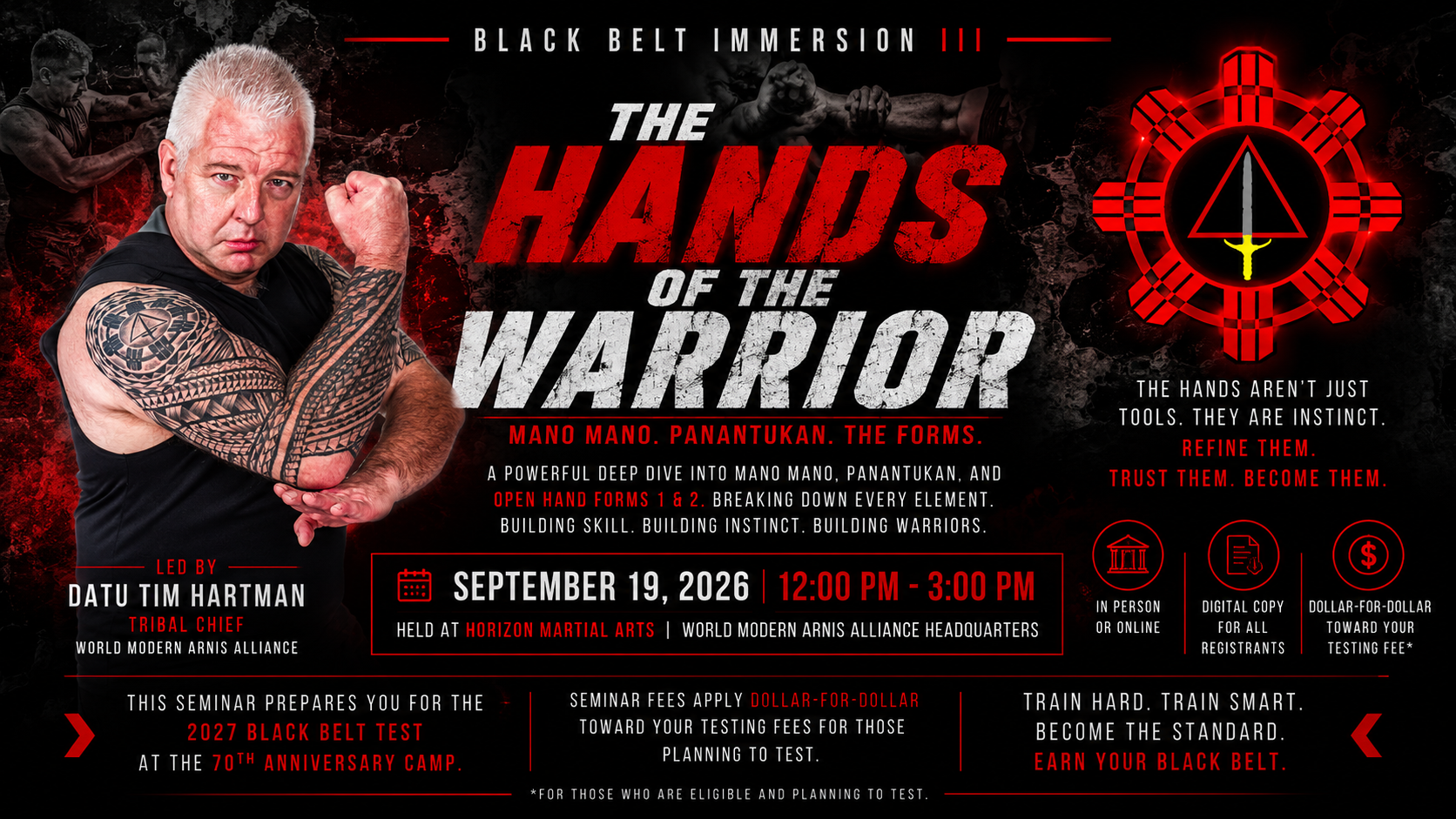
April 30th through May 2nd, 2027 — the 70th Anniversary of Modern Arnis Camp.

That one… is going to mean something special.

I’ll have more to say about it soon.

But for now?

A little rest.

A moment to breathe.

And then… back to work. Because classes are tonight.

To everyone who came, trained, tested, laughed, and shared this weekend—

Thank you.

Stay safe. Stay sane.

And keep the art alive.

Respectfully,
Datu Tim Hartman
Modern Arnis Tribal Chief

#modernarnis #martialarts #filipinomartialarts
Learning From a Master Doesn’t Always Make You a Student

Recently, I was listening to an FMA discussion podcast featuring several Modern Arnis practitioners when a comment by Bruce Chu of Florida really made me think.

He said:

“Professor had a lot of followers and participants, but not a lot of students.”

At first, that statement might sound controversial, but the more I thought about it, the more I understood exactly what he meant.

Professor Remy Presas introduced Modern Arnis to thousands of martial artists through seminars, camps, and demonstrations around the world. Those who attended absolutely learned from him, and many even hosted his events. His influence is beyond question.

But it raises an interesting question:

Does learning from a master automatically make you their student?

I don’t believe it does.

A student-teacher relationship is built through consistency, guidance, correction, accountability, and mutual commitment. It is an ongoing relationship, not simply a shared experience.

Here’s one way to look at it.

I’ve spoken with people who say they trained with Professor for ten years. That sounds impressive until you learn they may have only attended one seminar each year. If each seminar lasted five hours, that’s roughly fifty hours of instruction over an entire decade.

Now compare that to your own school.

If someone attended only five hours of class each year for ten years, would you consider them one of your active students? Most instructors probably wouldn’t. We’d likely describe them as someone who participated occasionally.

So why should the definition change simply because the instructor lived in another state or another country?

Distance doesn’t redefine the relationship. It only changes the opportunity for interaction.

My own experience was different.

I began training in Modern Arnis in 1985 and trained with Professor regularly for many years. Between monthly training, seminars, camps, private instruction, and extended weekends together, I estimate I accumulated well over 1,500 hours of direct training with him.

I don’t mention that to elevate my experience. I mention it to illustrate what an ongoing student-teacher relationship can look like. It was built over years of repeated instruction, correction, conversation, and mentorship—not just memorable seminars.

That doesn’t diminish anyone else’s experience.

A single seminar with a master can change the direction of your martial arts journey. You can learn lessons that stay with you for life.

But inspiration and mentorship are not always the same thing.

Learning from a master doesn’t always make you a student.

I’ve always made a distinction in my own school between participants, members, and students. Every person who walks through the door has value, but occasional participation isn’t the same as an ongoing student-teacher relationship.

The same applies to me.

I’ve attended seminars taught by exceptional martial artists throughout my career. I gladly give those instructors credit for what they taught me. But if I trained with someone once—or even several times—I wouldn’t honestly claim to be their student. I was a participant who had the privilege of learning from them.

The same principle applies outside of martial arts. I regularly attend business conferences and seminars where I learn from outstanding presenters. Their knowledge has helped me grow, but attending a presentation doesn’t make them my mentor. Just as in martial arts, a true student-teacher relationship requires an ongoing connection.

None of this diminishes Professor Presas’ legacy.

If anything, it highlights the extraordinary reach of his influence. Thousands learned from him. Thousands were inspired by him. His impact on Filipino Martial Arts is immeasurable.

At the same time, I believe we honor our teachers best by honestly describing the relationships we had with them.

Words matter.

Relationships matter.

Giving proper credit doesn’t diminish anyone’s experience—it puts it into its proper perspective.

So I’ll leave you with this question:

Where did your relationship with Professor fit? Were you a long-term student under his guidance, or were you someone who had the privilege of learning from him through seminars and camps? Both experiences have value—they’re simply different.

The original thought came from Bruce Chu, and I wanted to give him full credit for planting the seed for this discussion.

My goal isn’t to divide anyone or diminish anyone’s journey. It’s simply to encourage thoughtful reflection about what it truly means to be a student.

I’d genuinely like to hear your perspective.

Respectfully,
Datu Tim Hartman
The Tribal Chief