
(716) 247-5254 admin@wmarnis.com

One thing people don’t talk enough about when it comes to social media is the fallout that comes with visibility.

Everybody wants success… until they see what sometimes comes with it.

People ask me all the time if I’m worried about losing friends because of the content I put out.

Honestly? No.

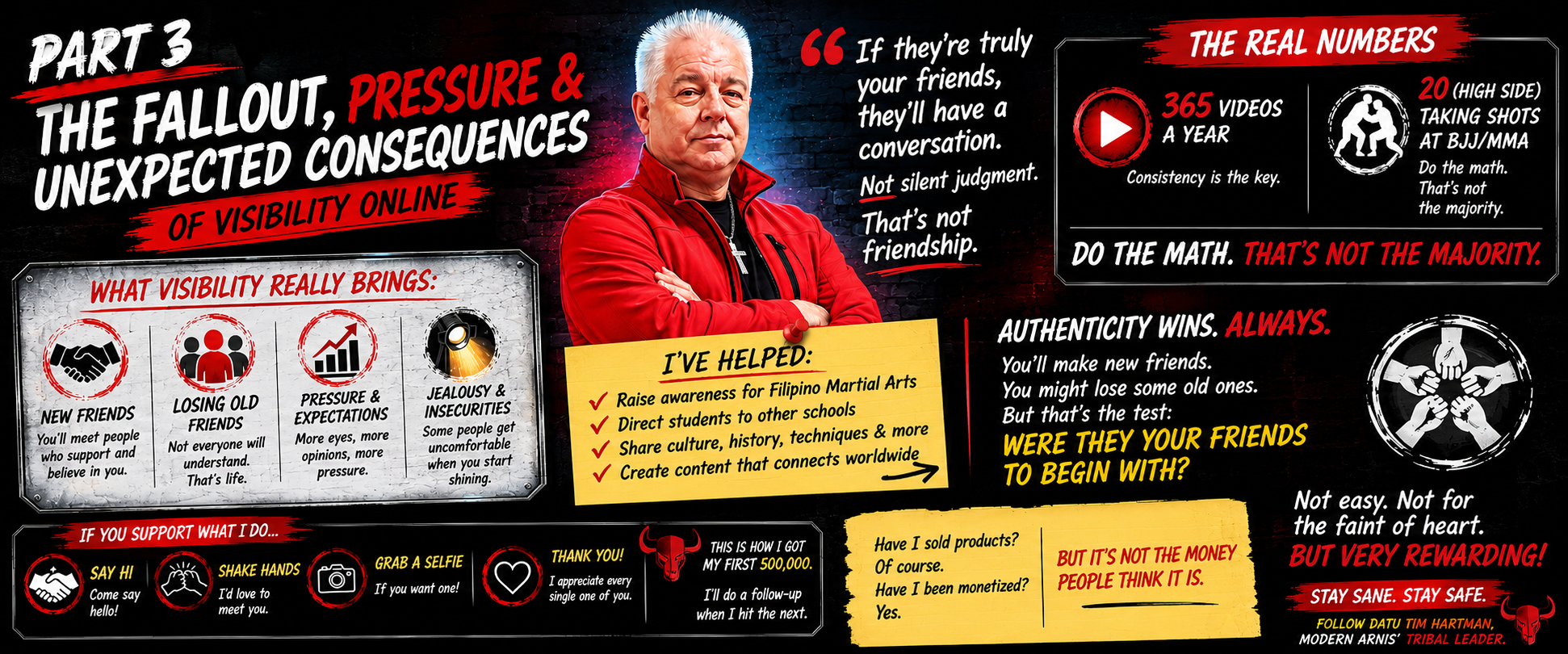
Because real friends have conversations.

They don’t silently judge you over a 30-second clip taken out of context. They don’t gossip behind your back or suddenly distance themselves without ever picking up the phone.

If someone truly has an issue with you, they talk to you.

That’s what real friends do.

But social media teaches you something very quickly:

Some people will applaud your success.

Some people will try to attach themselves to it.

And some people will absolutely become uncomfortable watching you succeed while they aren’t.

That’s reality.

The truth is, people build entire opinions about creators based on one controversial post while ignoring the other 95% of the content being produced.

I put out roughly 365 videos a year.

Even if maybe 20 of them poke fun at BJJ or MMA culture, that’s nowhere near the majority of what I do.

Do the math.

Most of my content is authentic martial arts, Filipino culture, training, humor, motivation, self-defense, and helping bring more awareness to Filipino Martial Arts worldwide.

What’s funny is I’ve had people tell me:
“All you do is bash BJJ.”

Then those SAME people will critique a Filipino history video or another piece of content I made.

And my response is simple:

Thank you for proving my point.

Because that means you ARE watching the rest of my content.

See, controversy sticks in people’s minds more than positivity does.

That’s human nature.

And honestly, when your content starts growing and theirs isn’t, some people get jealous, insecure, resentful, or uncomfortable.

Especially if they tried social media themselves and got an anemic response.

Before social media really took off for me, I’d spend hours writing blog posts that maybe got a couple hundred views.

Now I’ve got content reaching thousands, millions, and one walking cane video approaching 8 million views between Facebook and Instagram.

And ironically, those aren’t even the controversial videos.

That’s authentic martial arts connecting with real people.

Now I’ll also fully admit something else:

My communication style is blunt.

That’s how I was raised. I’m Gen X. We grew up in an era where people got to the point directly instead of carefully filtering every sentence through emotion first.

That doesn’t mean I’m trying to hurt people.

It just means I communicate honestly and directly.

And yes, social media will absolutely test relationships.

Some people you thought were in your corner won’t know how to handle your visibility.

Others will quietly root against you.

And some will surprise you by becoming your biggest supporters.

That’s just part of growth.

But at the end of the day, if someone distances themselves from you without ever having a conversation, you really have to ask yourself:

Were they truly your friend to begin with?

Social media can absolutely be rewarding, but it’s not for the faint of heart.

You need thick skin.

You need authenticity.

And most importantly, you need to separate real life from internet noise.

And honestly, if you ever see me somewhere and you follow my content, don’t hesitate to come say hello.

Seriously.

I’d love the opportunity to shake your hand, take a selfie, and personally thank you for supporting what I do.

Because none of this growth happens without all of you.

So that’s how I got my first 500,000 followers.

I’ll do another follow-up when I hit the next milestone.

Stay sane. Stay safe.

Datu Tim Hartman
Modern Arnis’ Tribal Leader

Learning From a Master Doesn’t Always Make You a Student

Recently, I was listening to an FMA discussion podcast featuring several Modern Arnis practitioners when a comment by Bruce Chu of Florida really made me think.

He said:

“Professor had a lot of followers and participants, but not a lot of students.”

At first, that statement might sound controversial, but the more I thought about it, the more I understood exactly what he meant.

Professor Remy Presas introduced Modern Arnis to thousands of martial artists through seminars, camps, and demonstrations around the world. Those who attended absolutely learned from him, and many even hosted his events. His influence is beyond question.

But it raises an interesting question:

Does learning from a master automatically make you their student?

I don’t believe it does.

A student-teacher relationship is built through consistency, guidance, correction, accountability, and mutual commitment. It is an ongoing relationship, not simply a shared experience.

Here’s one way to look at it.

I’ve spoken with people who say they trained with Professor for ten years. That sounds impressive until you learn they may have only attended one seminar each year. If each seminar lasted five hours, that’s roughly fifty hours of instruction over an entire decade.

Now compare that to your own school.

If someone attended only five hours of class each year for ten years, would you consider them one of your active students? Most instructors probably wouldn’t. We’d likely describe them as someone who participated occasionally.

So why should the definition change simply because the instructor lived in another state or another country?

Distance doesn’t redefine the relationship. It only changes the opportunity for interaction.

My own experience was different.

I began training in Modern Arnis in 1985 and trained with Professor regularly for many years. Between monthly training, seminars, camps, private instruction, and extended weekends together, I estimate I accumulated well over 1,500 hours of direct training with him.

I don’t mention that to elevate my experience. I mention it to illustrate what an ongoing student-teacher relationship can look like. It was built over years of repeated instruction, correction, conversation, and mentorship—not just memorable seminars.

That doesn’t diminish anyone else’s experience.

A single seminar with a master can change the direction of your martial arts journey. You can learn lessons that stay with you for life.

But inspiration and mentorship are not always the same thing.

Learning from a master doesn’t always make you a student.

I’ve always made a distinction in my own school between participants, members, and students. Every person who walks through the door has value, but occasional participation isn’t the same as an ongoing student-teacher relationship.

The same applies to me.

I’ve attended seminars taught by exceptional martial artists throughout my career. I gladly give those instructors credit for what they taught me. But if I trained with someone once—or even several times—I wouldn’t honestly claim to be their student. I was a participant who had the privilege of learning from them.

The same principle applies outside of martial arts. I regularly attend business conferences and seminars where I learn from outstanding presenters. Their knowledge has helped me grow, but attending a presentation doesn’t make them my mentor. Just as in martial arts, a true student-teacher relationship requires an ongoing connection.

None of this diminishes Professor Presas’ legacy.

If anything, it highlights the extraordinary reach of his influence. Thousands learned from him. Thousands were inspired by him. His impact on Filipino Martial Arts is immeasurable.

At the same time, I believe we honor our teachers best by honestly describing the relationships we had with them.

Words matter.

Relationships matter.

Giving proper credit doesn’t diminish anyone’s experience—it puts it into its proper perspective.

So I’ll leave you with this question:

Where did your relationship with Professor fit? Were you a long-term student under his guidance, or were you someone who had the privilege of learning from him through seminars and camps? Both experiences have value—they’re simply different.

The original thought came from Bruce Chu, and I wanted to give him full credit for planting the seed for this discussion.

My goal isn’t to divide anyone or diminish anyone’s journey. It’s simply to encourage thoughtful reflection about what it truly means to be a student.

I’d genuinely like to hear your perspective.

Respectfully,
Datu Tim Hartman
The Tribal Chief