(716) 247-5254 admin@wmarnis.com

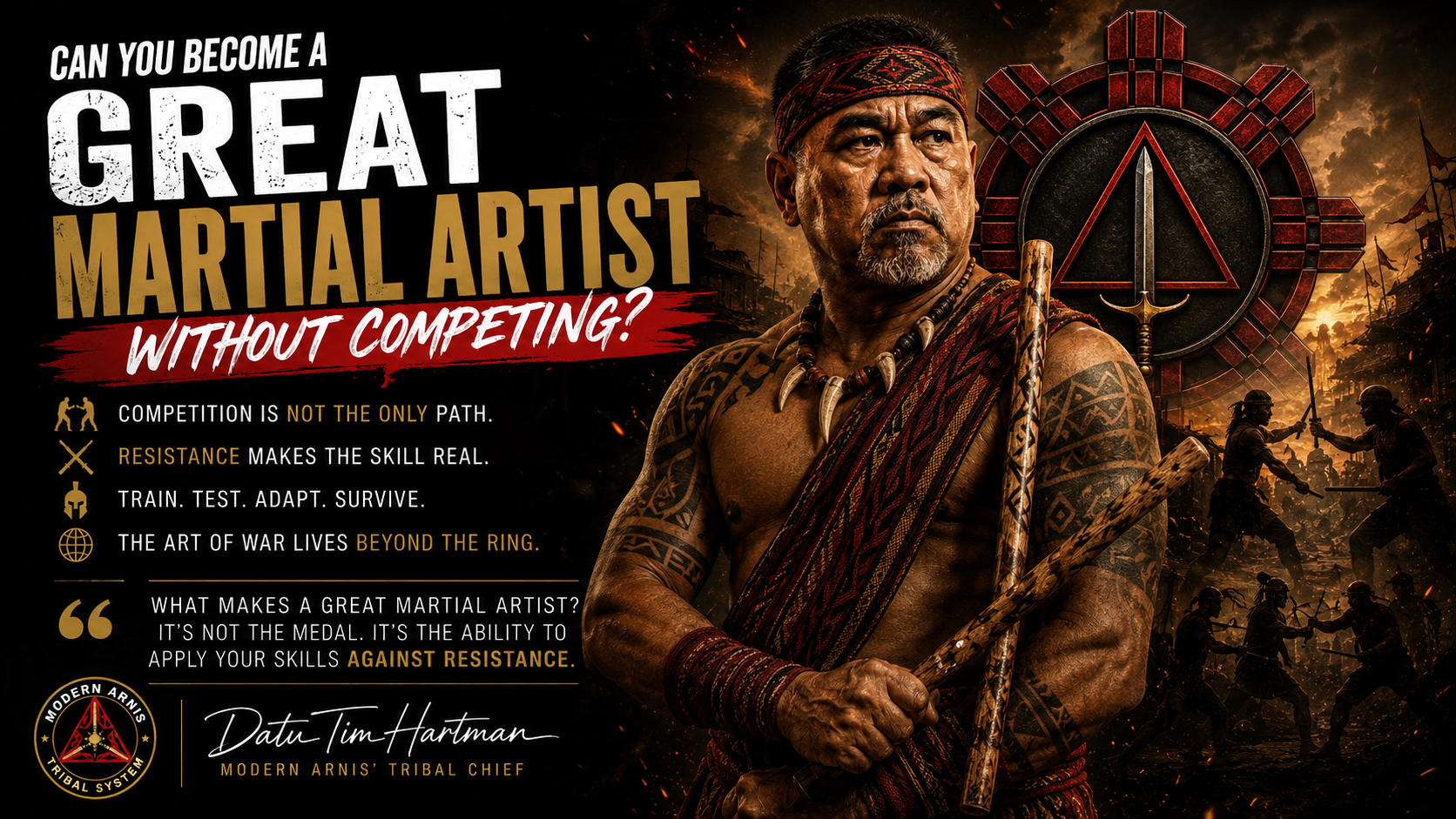
A friend recently asked me an interesting question: Can you become a great martial artist without ever competing?

My answer is yes—but not necessarily for everyone.

Competition is not the only path to becoming a great martial artist. However, what competition does provide is something incredibly important: a non-compliant opponent. Someone who is actively trying to stop you, defeat you, or impose their will on you.

So perhaps the better question is this: Can you become a great martial artist without ever training against resistance?

On that point, I would disagree.

Many phenomenal martial artists never became tournament champions, but they still developed their skills against resisting opponents. They sparred. They fought in the ring. They tested themselves under pressure. Some even fought for their lives in real-world situations. The common denominator wasn’t competition itself—it was resistance.

Take my teacher, the late Grandmaster Remy Presas. He was a world-renowned martial artist and a living legend. Yet much of his experience came from fighting in the streets of the Philippines with real weapons, no protective gear, and opponents who were genuinely trying to hurt him. That’s as non-compliant as it gets.

Now, is that different from a tournament match? Absolutely. The level of violence is different. The consequences are different. But at its core, both experiences involve dealing with an opponent who is resisting and forcing you to apply your skills under pressure.

That’s why I don’t believe you must enter tournaments to become a great martial artist. I do believe, however, that you need training methods that realistically simulate combat. Resistance training, sparring, pressure testing, and realistic drills are all essential elements. Competition is one way to achieve that, but it isn’t the only way.

Look at military personnel. Many of them never step into a tournament ring, yet they embody the essence of martial skill. Martial arts literally means “the arts of war.” These men and women train extensively, deploy into dangerous environments, and gain real-world experience under conditions most people can barely imagine. Their path may not focus on trophies, medals, or even the philosophical aspects of martial arts, but when it comes to the art of combat, they possess a level of experience that commands respect.

The same can be said for many instructors from previous generations. Whether their experience came from the streets, the ring, military service, law enforcement, or intensive sparring, they developed their abilities by testing themselves against resistance.

Ultimately, the real question isn’t whether someone competes. The real question is what makes a great martial artist.

Technical skill matters. Knowledge matters. Character matters. Teaching ability matters. But the ability to apply your skills against resistance—whether in competition, sparring, real-world encounters, or other forms of pressure testing—is a critical piece of the puzzle.

That’s my opinion.

Respectfully,

Datu Tim Hartman
Modern Arnis Tribal Chief

Learning From a Master Doesn’t Always Make You a Student

Recently, I was listening to an FMA discussion podcast featuring several Modern Arnis practitioners when a comment by Bruce Chu of Florida really made me think.

He said:

“Professor had a lot of followers and participants, but not a lot of students.”

At first, that statement might sound controversial, but the more I thought about it, the more I understood exactly what he meant.

Professor Remy Presas introduced Modern Arnis to thousands of martial artists through seminars, camps, and demonstrations around the world. Those who attended absolutely learned from him, and many even hosted his events. His influence is beyond question.

But it raises an interesting question:

Does learning from a master automatically make you their student?

I don’t believe it does.

A student-teacher relationship is built through consistency, guidance, correction, accountability, and mutual commitment. It is an ongoing relationship, not simply a shared experience.

Here’s one way to look at it.

I’ve spoken with people who say they trained with Professor for ten years. That sounds impressive until you learn they may have only attended one seminar each year. If each seminar lasted five hours, that’s roughly fifty hours of instruction over an entire decade.

Now compare that to your own school.

If someone attended only five hours of class each year for ten years, would you consider them one of your active students? Most instructors probably wouldn’t. We’d likely describe them as someone who participated occasionally.

So why should the definition change simply because the instructor lived in another state or another country?

Distance doesn’t redefine the relationship. It only changes the opportunity for interaction.

My own experience was different.

I began training in Modern Arnis in 1985 and trained with Professor regularly for many years. Between monthly training, seminars, camps, private instruction, and extended weekends together, I estimate I accumulated well over 1,500 hours of direct training with him.

I don’t mention that to elevate my experience. I mention it to illustrate what an ongoing student-teacher relationship can look like. It was built over years of repeated instruction, correction, conversation, and mentorship—not just memorable seminars.

That doesn’t diminish anyone else’s experience.

A single seminar with a master can change the direction of your martial arts journey. You can learn lessons that stay with you for life.

But inspiration and mentorship are not always the same thing.

Learning from a master doesn’t always make you a student.

I’ve always made a distinction in my own school between participants, members, and students. Every person who walks through the door has value, but occasional participation isn’t the same as an ongoing student-teacher relationship.

The same applies to me.

I’ve attended seminars taught by exceptional martial artists throughout my career. I gladly give those instructors credit for what they taught me. But if I trained with someone once—or even several times—I wouldn’t honestly claim to be their student. I was a participant who had the privilege of learning from them.

The same principle applies outside of martial arts. I regularly attend business conferences and seminars where I learn from outstanding presenters. Their knowledge has helped me grow, but attending a presentation doesn’t make them my mentor. Just as in martial arts, a true student-teacher relationship requires an ongoing connection.

None of this diminishes Professor Presas’ legacy.

If anything, it highlights the extraordinary reach of his influence. Thousands learned from him. Thousands were inspired by him. His impact on Filipino Martial Arts is immeasurable.

At the same time, I believe we honor our teachers best by honestly describing the relationships we had with them.

Words matter.

Relationships matter.

Giving proper credit doesn’t diminish anyone’s experience—it puts it into its proper perspective.

So I’ll leave you with this question:

Where did your relationship with Professor fit? Were you a long-term student under his guidance, or were you someone who had the privilege of learning from him through seminars and camps? Both experiences have value—they’re simply different.

The original thought came from Bruce Chu, and I wanted to give him full credit for planting the seed for this discussion.

My goal isn’t to divide anyone or diminish anyone’s journey. It’s simply to encourage thoughtful reflection about what it truly means to be a student.

I’d genuinely like to hear your perspective.

Respectfully,
Datu Tim Hartman
The Tribal Chief