
(716) 247-5254 admin@wmarnis.com

Creating content is WORK. A lot more work than most people realize.

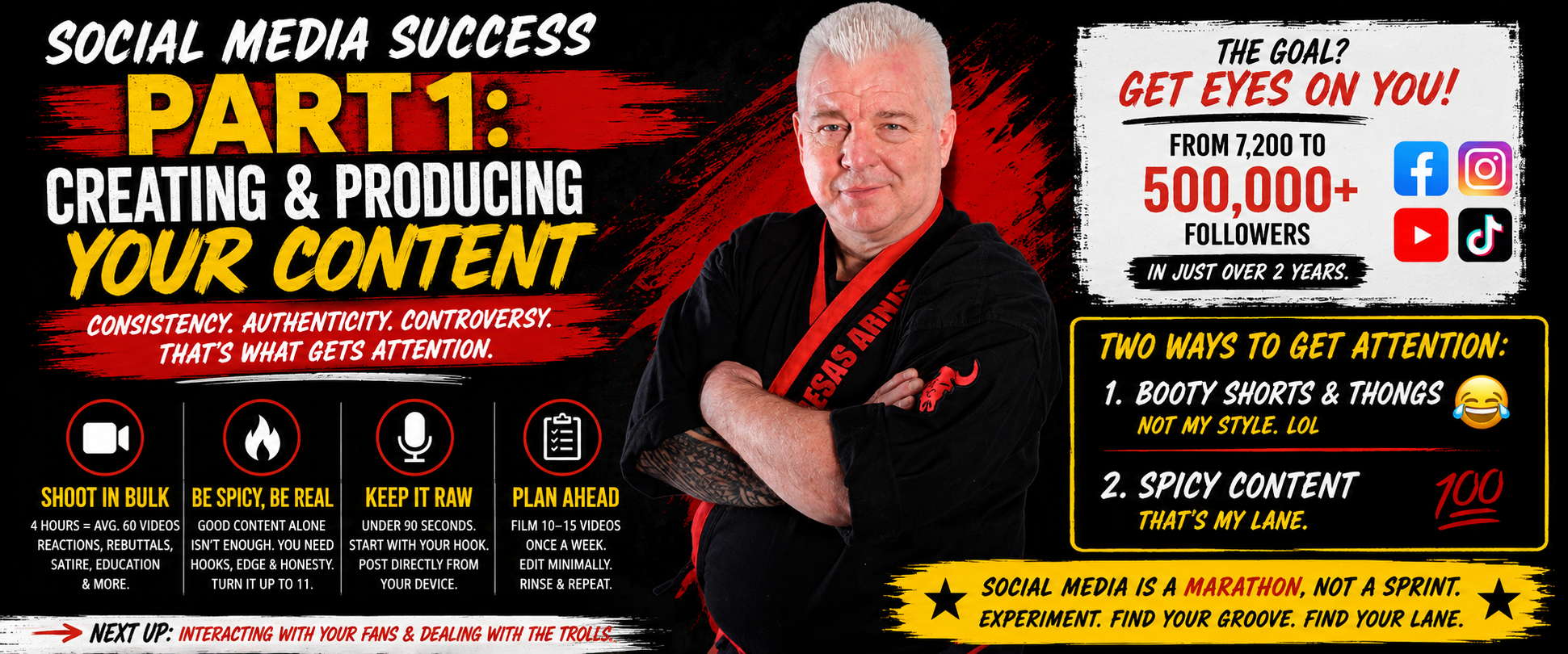
One of the biggest keys to social media success is consistency. You have to keep putting content out regularly. That’s probably the most important thing right there.

For me, my team comes in and during about a four-hour filming session, we’ll shoot around 60 videos. Some are reaction videos, some are rebuttals, some are satire, and some are just solid educational content.

But here’s the reality…

Good content alone usually isn’t enough.

To catch people’s attention online, you need hooks. You need edge. You need topics that make people stop scrolling.

Now there are basically two ways to grab attention online.

One is walking around in booty shorts and thongs trying to thirst trap everybody. Fortunately — or unfortunately for all of you — I’m never going to do that. LOL.

So that leaves spicy content.

Now let me be clear — I don’t make things up for clicks. I don’t say things I don’t believe in. But I DO know how to turn the volume up to 11 to get people paying attention.

One example was when I said, “The UFC is not real.”

That exploded online.

Of course the CONTACT is real. Fighters are getting knocked out, injured, and seriously hurt.

But what I was talking about was CONTEXT.

UFC is still a martial sport with rules, safety measures, referees, medical staff, weight classes, and regulations. It’s controlled combat.

That’s different from real-world violence on concrete, asphalt, in bars, parking lots, against armed attackers, or multiple attackers.

Now in a 50-90 second video, you can’t explain every nuance perfectly. People hear one sentence and instantly react. I was never saying fighters can’t fight. I was saying sport and survival are not the same thing.

But controversy gets attention.

And yes… trolls absolutely came flooding in. I’ll talk more about dealing with trolls in the next part of this series.

But understand this:

Spicy content gets eyes on your page.

And attention drives growth.

I went from around 7,200 followers to over 500,000 followers across four platforms in just over two years.

Another important thing…

Keep your content RAW.

People today prefer content that feels real instead of overproduced. Keep most videos under 90 seconds and hit them immediately with a strong hook.

And no, “hook” doesn’t mean lying. It means giving people a reason to stop scrolling and listen.

Now personally, I never use scripts. But that comes from my background in performing arts and decades of teaching seminars around the world. Public speaking, seminars, podcasts, interviews — all of that taught me how to think on my feet and stay natural on camera.

That allows me to stay honest, organic, and real when filming.

Most of the time my team can walk up and say, “Talk about this,” and 30 seconds later we’re filming.

But not everybody works that way, and that’s okay.

My advice is to write your ideas down ahead of time. Film once a week if possible and try knocking out 10-15 videos in one session. Keep the editing simple and start preparing your next batch while the current videos are posting.

As far as equipment goes, the two biggest things are lighting and audio.

I use remote mics and a boom mic setup, but honestly, you don’t need expensive gear anymore. Modern cell phones can do a LOT.

You also need a good team around you.

One thing I strongly recommend is checking your videos before posting them. Don’t overthink everything because people DO like authenticity, but make sure it’s still something you’re proud of.

Out of the 760+ videos I’ve done so far, there are probably 10 or 20 I wish I could redo.

That’s part of the process.

Social media is a marathon, not a sprint.

Experiment. Learn. Adjust. Find your groove and find your lane.

Next topic:
Interacting with your fans… and dealing with the trolls.

Learning From a Master Doesn’t Always Make You a Student

Recently, I was listening to an FMA discussion podcast featuring several Modern Arnis practitioners when a comment by Bruce Chu of Florida really made me think.

He said:

“Professor had a lot of followers and participants, but not a lot of students.”

At first, that statement might sound controversial, but the more I thought about it, the more I understood exactly what he meant.

Professor Remy Presas introduced Modern Arnis to thousands of martial artists through seminars, camps, and demonstrations around the world. Those who attended absolutely learned from him, and many even hosted his events. His influence is beyond question.

But it raises an interesting question:

Does learning from a master automatically make you their student?

I don’t believe it does.

A student-teacher relationship is built through consistency, guidance, correction, accountability, and mutual commitment. It is an ongoing relationship, not simply a shared experience.

Here’s one way to look at it.

I’ve spoken with people who say they trained with Professor for ten years. That sounds impressive until you learn they may have only attended one seminar each year. If each seminar lasted five hours, that’s roughly fifty hours of instruction over an entire decade.

Now compare that to your own school.

If someone attended only five hours of class each year for ten years, would you consider them one of your active students? Most instructors probably wouldn’t. We’d likely describe them as someone who participated occasionally.

So why should the definition change simply because the instructor lived in another state or another country?

Distance doesn’t redefine the relationship. It only changes the opportunity for interaction.

My own experience was different.

I began training in Modern Arnis in 1985 and trained with Professor regularly for many years. Between monthly training, seminars, camps, private instruction, and extended weekends together, I estimate I accumulated well over 1,500 hours of direct training with him.

I don’t mention that to elevate my experience. I mention it to illustrate what an ongoing student-teacher relationship can look like. It was built over years of repeated instruction, correction, conversation, and mentorship—not just memorable seminars.

That doesn’t diminish anyone else’s experience.

A single seminar with a master can change the direction of your martial arts journey. You can learn lessons that stay with you for life.

But inspiration and mentorship are not always the same thing.

Learning from a master doesn’t always make you a student.

I’ve always made a distinction in my own school between participants, members, and students. Every person who walks through the door has value, but occasional participation isn’t the same as an ongoing student-teacher relationship.

The same applies to me.

I’ve attended seminars taught by exceptional martial artists throughout my career. I gladly give those instructors credit for what they taught me. But if I trained with someone once—or even several times—I wouldn’t honestly claim to be their student. I was a participant who had the privilege of learning from them.

The same principle applies outside of martial arts. I regularly attend business conferences and seminars where I learn from outstanding presenters. Their knowledge has helped me grow, but attending a presentation doesn’t make them my mentor. Just as in martial arts, a true student-teacher relationship requires an ongoing connection.

None of this diminishes Professor Presas’ legacy.

If anything, it highlights the extraordinary reach of his influence. Thousands learned from him. Thousands were inspired by him. His impact on Filipino Martial Arts is immeasurable.

At the same time, I believe we honor our teachers best by honestly describing the relationships we had with them.

Words matter.

Relationships matter.

Giving proper credit doesn’t diminish anyone’s experience—it puts it into its proper perspective.

So I’ll leave you with this question:

Where did your relationship with Professor fit? Were you a long-term student under his guidance, or were you someone who had the privilege of learning from him through seminars and camps? Both experiences have value—they’re simply different.

The original thought came from Bruce Chu, and I wanted to give him full credit for planting the seed for this discussion.

My goal isn’t to divide anyone or diminish anyone’s journey. It’s simply to encourage thoughtful reflection about what it truly means to be a student.

I’d genuinely like to hear your perspective.

Respectfully,
Datu Tim Hartman
The Tribal Chief