
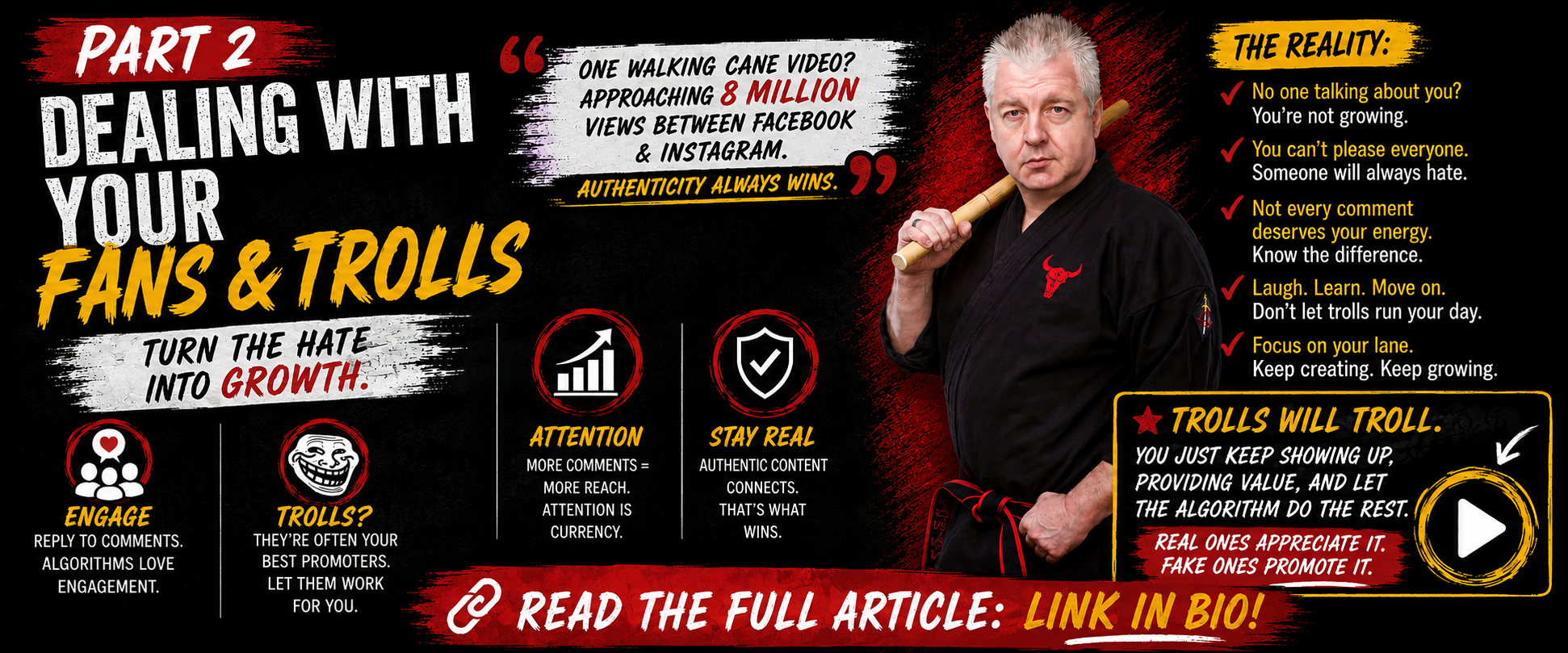
Part 2 — Dealing With the Trolls
One of the questions I get asked the most is:
“How do you deal with trolls?”
Simple.
You let them work for you.
Whether people realize it or not, trolls are often your biggest promoters. If nobody’s talking about you — good or bad — then chances are you’re probably not making much noise online.
Now don’t get me wrong, I’m not saying it never gets annoying. Sometimes it absolutely does. But after a while, you start realizing something important:
Social media platforms don’t care whether engagement is positive or negative.
They just care that people are engaging.
Comments, shares, reactions, arguments, debates… all of it feeds the algorithm. The machine doesn’t understand the “quality” of your content. It understands activity. If people are talking about your post, the platform assumes it’s interesting and starts pushing it farther.
That’s why, especially when you’re first starting out, you should engage with people.
Reply to comments.
Thank supporters.
Throw a thumbs up back at somebody.
Even critics can help boost your content if you engage the right way.
Attention is currency online.
And honestly, this isn’t even new. It’s just an updated version of an old media strategy:
“If it bleeds, it leads.”
Now obviously there’s a line. If somebody becomes abusive, threatening, or starts harassing your followers, then block them or report them. I’ve had to do that before too. Some people completely cross the line online because they think anonymity protects them.
And the funny thing is, most of these trolls don’t even use real accounts. You click their page and it’s empty — no posts, no pictures, no life. The account exists solely so they can take shots at people.
Heck, sometimes it might even be people you know personally.
But honestly, most trolls aren’t real threats. They’re just angry people screaming into the void because they want attention too.
Personally, I don’t let it bother me much. I’m Gen X. We grew up busting chops constantly, so most insults online don’t even register anymore.
People body shame me, mock me, challenge me to fights, say ridiculous stuff… and honestly, I usually just laugh.
I’ve had people tell me I look like the love child of John Madden and Guy Fieri. My response? “I’m too old to be their kid.”
At the end of the day, if somebody keeps watching your videos just so they can complain…
they’re still watching.
That’s the part they don’t understand.
Now of course, you’ve also got the “internet warriors” who challenge everybody online. I’ve had people invite me to fly across the country on my own dime just to fight them in somebody’s backyard promotion while everyone else profits off the content.
That’s not a challenge. That’s stupidity.
Meanwhile, I’ve spent decades teaching martial arts around the world. I’ve taught in 28 states and 18 countries, built a platform of over 500,000 followers, and produced multiple videos with millions of views.
And ironically, my biggest viral content usually ISN’T the controversial stuff.
Right now I’ve got a walking cane video approaching 8 million views between Facebook and Instagram alone.
That’s authentic martial arts content connecting with people — not manufactured drama.
Now do I poke the MMA and BJJ crowd sometimes?
Of course I do.
But that’s maybe one or two videos a month. The internet just amplifies controversy louder than everything else.
And for the record, I actually train in Brazilian Jiu-Jitsu and have even helped produce a cage fighting champion in the past. But online narratives are funny. People take one or two controversial clips and suddenly act like that’s your entire identity.
The biggest lesson I can give people is this:
Don’t fake outrage just for clicks.
Don’t become a character you can’t maintain.
Be authentic.
Stand on your opinions.
Have fun with it.
And understand that once your platform starts growing, trolls are simply part of the game.
Next up:
The fallout, pressure, and unexpected consequences that come with visibility online.