
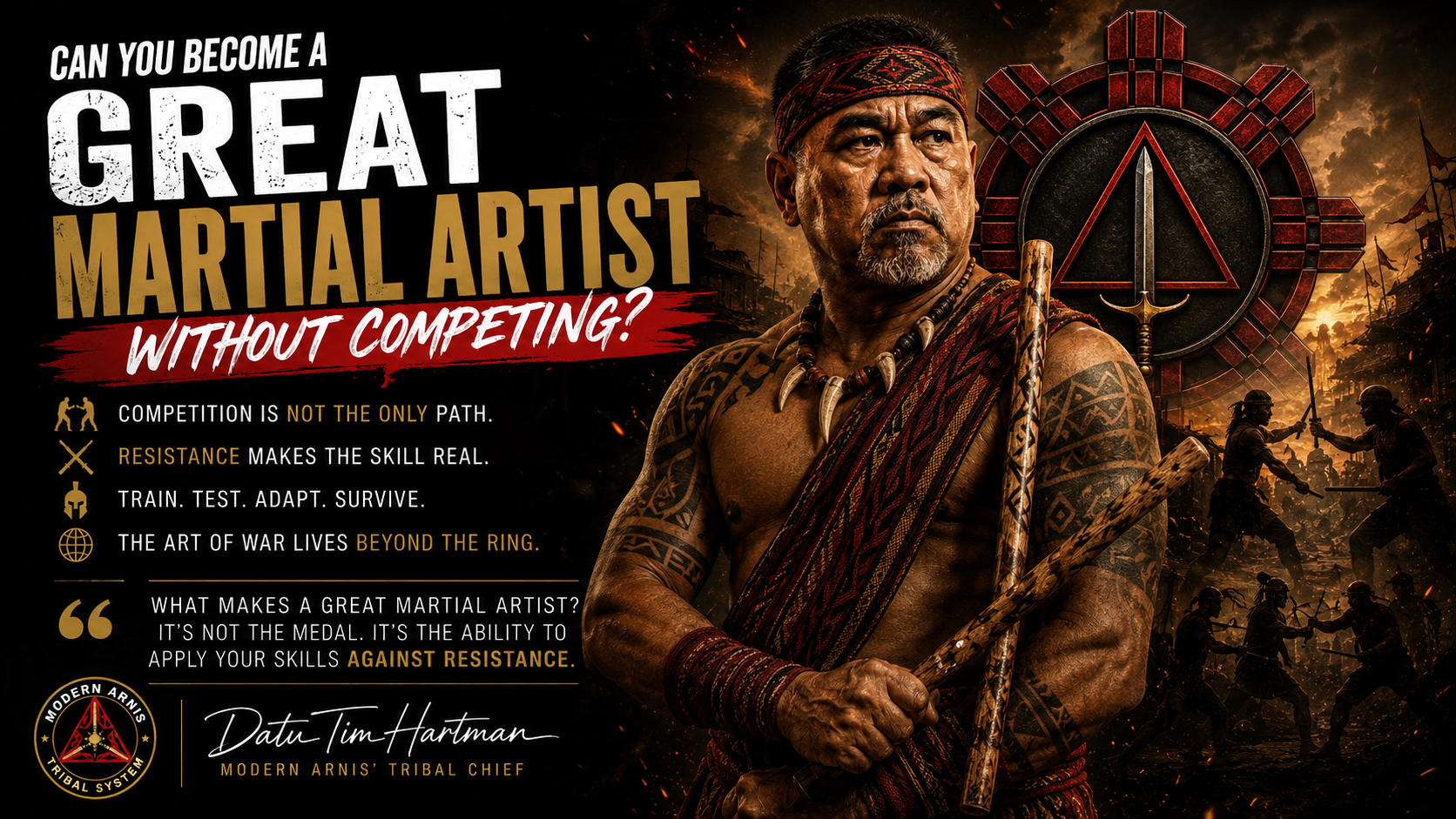
A friend recently asked me an interesting question: Can you become a great martial artist without ever competing?
My answer is yes—but not necessarily for everyone.
Competition is not the only path to becoming a great martial artist. However, what competition does provide is something incredibly important: a non-compliant opponent. Someone who is actively trying to stop you, defeat you, or impose their will on you.
So perhaps the better question is this: Can you become a great martial artist without ever training against resistance?
On that point, I would disagree.
Many phenomenal martial artists never became tournament champions, but they still developed their skills against resisting opponents. They sparred. They fought in the ring. They tested themselves under pressure. Some even fought for their lives in real-world situations. The common denominator wasn’t competition itself—it was resistance.
Take my teacher, the late Grandmaster Remy Presas. He was a world-renowned martial artist and a living legend. Yet much of his experience came from fighting in the streets of the Philippines with real weapons, no protective gear, and opponents who were genuinely trying to hurt him. That’s as non-compliant as it gets.
Now, is that different from a tournament match? Absolutely. The level of violence is different. The consequences are different. But at its core, both experiences involve dealing with an opponent who is resisting and forcing you to apply your skills under pressure.
That’s why I don’t believe you must enter tournaments to become a great martial artist. I do believe, however, that you need training methods that realistically simulate combat. Resistance training, sparring, pressure testing, and realistic drills are all essential elements. Competition is one way to achieve that, but it isn’t the only way.
Look at military personnel. Many of them never step into a tournament ring, yet they embody the essence of martial skill. Martial arts literally means “the arts of war.” These men and women train extensively, deploy into dangerous environments, and gain real-world experience under conditions most people can barely imagine. Their path may not focus on trophies, medals, or even the philosophical aspects of martial arts, but when it comes to the art of combat, they possess a level of experience that commands respect.
The same can be said for many instructors from previous generations. Whether their experience came from the streets, the ring, military service, law enforcement, or intensive sparring, they developed their abilities by testing themselves against resistance.
Ultimately, the real question isn’t whether someone competes. The real question is what makes a great martial artist.
Technical skill matters. Knowledge matters. Character matters. Teaching ability matters. But the ability to apply your skills against resistance—whether in competition, sparring, real-world encounters, or other forms of pressure testing—is a critical piece of the puzzle.
That’s my opinion.
Respectfully,
Datu Tim Hartman
Modern Arnis Tribal Chief


