Welcome to the World Modern Arnis Alliance
The World’s Leading Organization Promoting Presas Family Arnis!
Balintawak Imersion Camp:
July 17 – 19, 2026
Day(s)
:
Hour(s)
:
Minute(s)
:
Second(s)
Announcement: Datu’s newest disarm course. Check it out here!

Stick It to Hunger 2025 – A Smashing Success!
Stick It to Hunger 2025 – A Smashing Success! This weekend, Horizon Martial Arts hosted the 2nd annual fundraiser for the West Seneca Food Bank, and this year’s theme said it all: Stick It to Hunger! This was an official event of the World Modern Arnis Alliance, part...

No Lineage? No Legitimacy.
No Lineage? No Legitimacy. I’ve been seeing a lot of people lately—especially in the MMA, BJJ, and even FMA communities—saying that lineage doesn’t matter. And here’s my honest take: when someone says that, it’s usually because they don’t have one. Yes, doing the work...

Accountability Isn’t Being a Hater—It’s About Protecting the Truth
Accountability Isn’t Being a Hater—It’s About Protecting the Truth Let’s clear something up—especially within the Modern Arnis community—accountability is not the same as persecution. When I speak up to correct something, it’s not about attacking anyone. It’s not...

How Do You Define Success?
How Do You Define Success? That question has been bouncing around in my head a lot lately. Success can be measured in so many different ways—attendance numbers, revenue, social media buzz, or how many people walked away from an event with something meaningful. For me,...
What is Modern Arnis
Modern Arnis is a Filipino martial art that was founded by Remy Presas in 1957. It is also sometimes referred to as “Modern Arnis de Manila” or simply “Arnis”.
Modern Arnis incorporates a wide range of striking, grappling, and weapons techniques, with an emphasis on stick and knife fighting. Practitioners learn to use a variety of weapons, including sticks, knives, swords, and other improvised weapons, as well as empty-hand techniques.
The system emphasizes fluid, flowing movements and employs a variety of striking, blocking, and disarming techniques to neutralize an opponent’s attacks. Modern Arnis is often taught as a practical self-defense system, but can also be practiced as a sport, with practitioners sparring and competing in tournaments.
In addition to its practical applications, Modern Arnis also has a rich cultural heritage and is often studied for its historical and artistic value. It is a popular martial art in the Philippines and has also gained a following in other parts of the world.
About the WMAA
The World Modern Arnis Alliance (WMAA) is an international organization that promotes and teaches the Filipino martial art of Modern Arnis. Modern Arnis was developed by Grandmaster Remy Amador Presas, who blended traditional Filipino stick fighting techniques with influences from other martial arts such as Judo, Karate, and Boxing.
The WMAA was founded in 2001 and is headquartered in the United States. It is led by Grandmaster Datu Tim Hartman, who trained directly under Grandmaster Presas. The organization aims to preserve, promote, and develop Modern Arnis by providing standardized training, testing, and certification for instructors and students, as well as organizing seminars, workshops, and tournaments.
The WMAA also emphasizes the practical applications of Modern Arnis in self-defense situations, as well as its value in promoting physical fitness, mental discipline, and cultural awareness. The organization has members and affiliates in 12 countries and holds an annual International Training Camp and Festival to bring together practitioners from around the world.
Upcoming WMAA Events



Some of the WMAA Training Programs
Modern Arnis is a Filipino martial art that was founded by Remy Presas in 1957. It is also sometimes referred to as “Modern Arnis de Manila” or simply “Arnis”.
Modern Arnis incorporates a wide range of striking, grappling, and weapons techniques, with an emphasis on stick and knife fighting. Practitioners learn to use a variety of weapons, including sticks, knives, swords, and other improvised weapons, as well as empty-hand techniques.
The system emphasizes fluid, flowing movements and employs a variety of striking, blocking, and disarming techniques to neutralize an opponent’s attacks. Modern Arnis is often taught as a practical self-defense system, but can also be practiced as a sport, with practitioners sparring and competing in tournaments.
Kombatan is a Filipino martial art that primarily focuses on weapon-based fighting techniques. It is also known as “Kombatan Arnis” or “Kombatan Eskrima,” and it is one of the many traditional martial arts systems that originated in the Philippines.
Kombatan techniques involve the use of sticks, knives, and other bladed weapons, as well as empty-hand combat. The system emphasizes practical self-defense techniques that can be used in real-world situations, and it also incorporates concepts such as footwork, timing, and distance control.
Kombatan was founded by Ernesto A. Presas in the 1980s, and it has since spread to many countries around the world, including the United States, Canada, Australia, and several European countries.

Panantukan is a Filipino martial art that focuses on striking with the hands, similar to Western boxing. It is also sometimes called “Suntukan,” which means “to strike” or “to hit” in Tagalog, the language spoken in the Philippines. Panantukan emphasizes close-range combat and uses punches, elbow strikes, and other hand strikes to attack an opponent’s vital targets. It also includes footwork, defense techniques, and grappling moves. Panantukan is often taught as part of the curriculum in Filipino martial arts schools and is also used by law enforcement and military personnel in the Philippines.

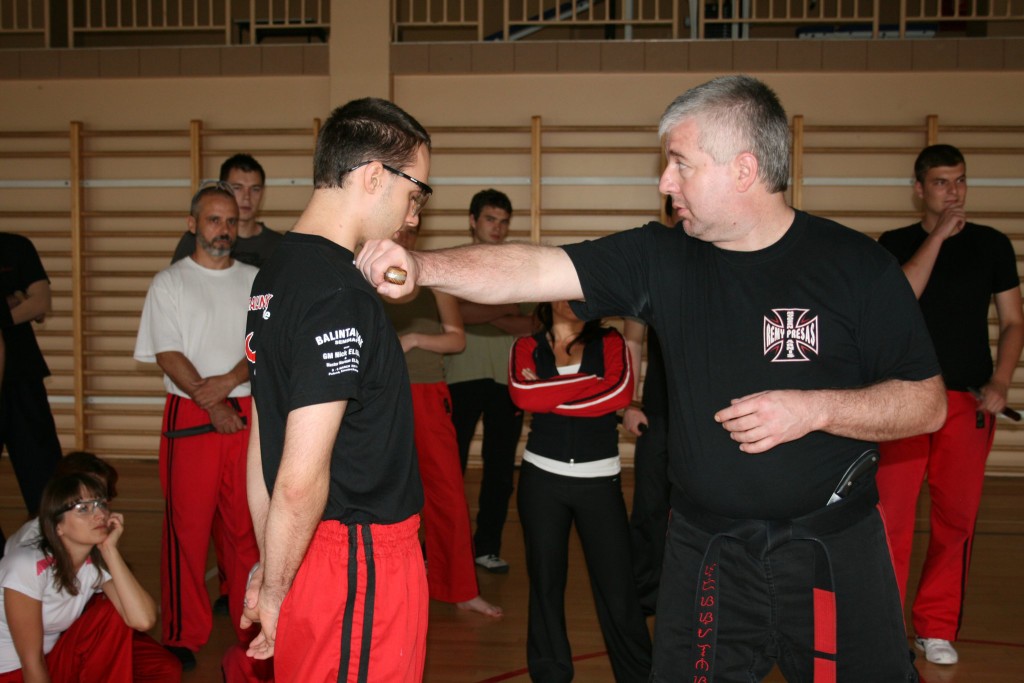
Balintawak is a Filipino martial art that primarily focuses on close-quarters combat and self-defense techniques. It is also known as “Balintawak Eskrima” and it is one of the many traditional martial arts systems that originated in the Philippines.
Balintawak techniques involve the use of single stick combat. The system emphasizes fast and efficient movements, as well as footwork and timing, to quickly and effectively neutralize an opponent. Balintawak is known for its flowing, dynamic movements and its practical approach to self-defense.
Balintawak was founded by Venancio “Anciong” Bacon in the 1950s, and it has since spread to many countries around the world. Today, Balintawak is recognized as a modern and effective martial art, and it is practiced by both civilians and military personnel for self-defense and combat training.


Want to Join The World Modern Arnis?
Join our growing family promoting one of the most progesssive Filipino Martial Arts!