
Learning From a Master Doesn’t Always Make You a Student

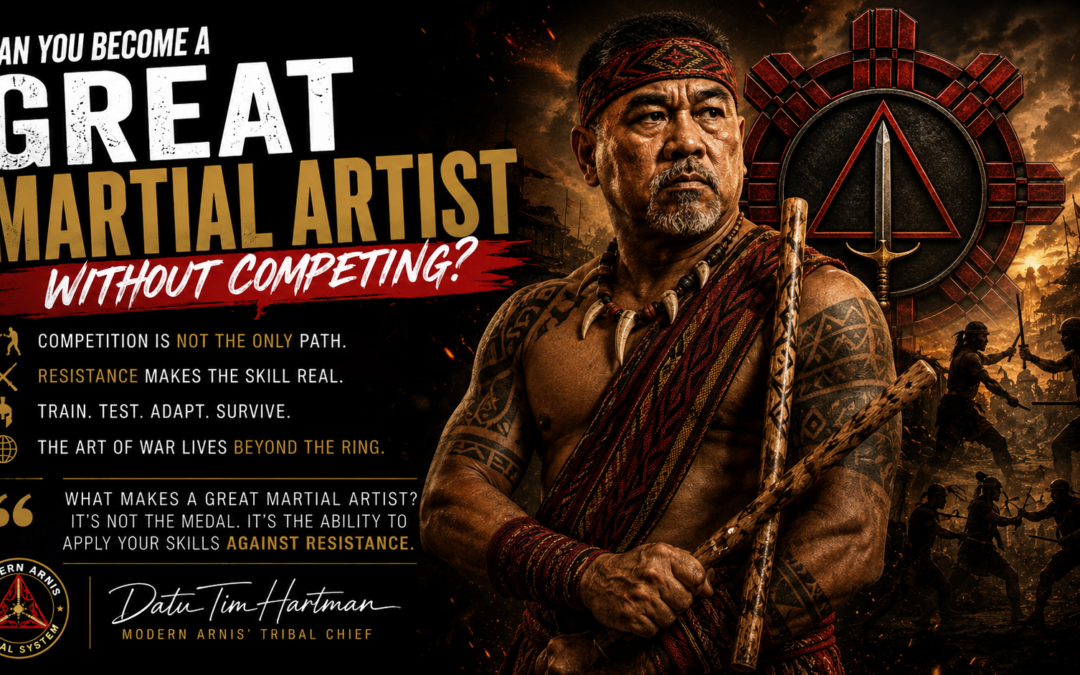
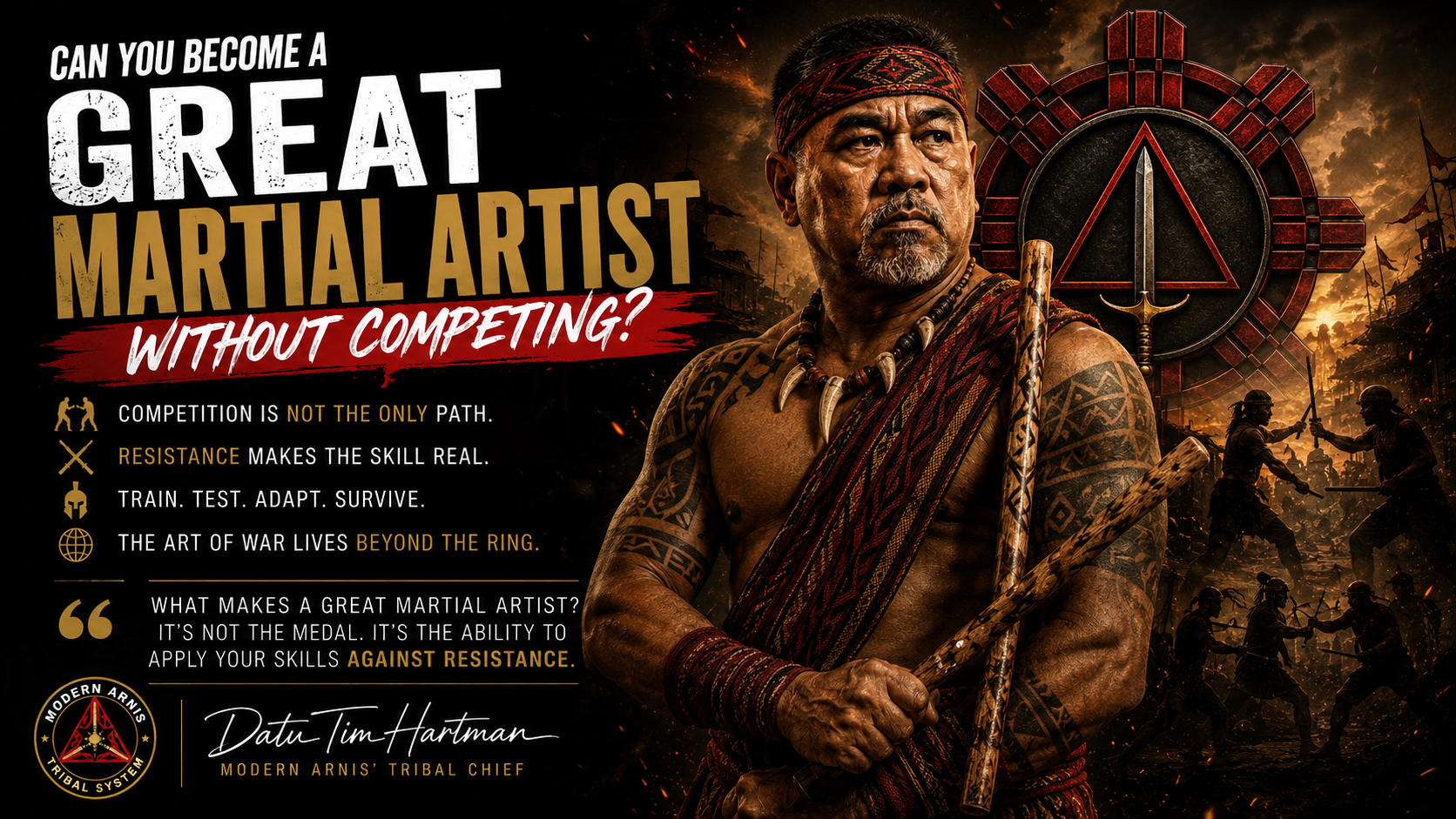
A friend recently asked me an interesting question: Can you become a great martial artist without ever competing?
My answer is yes—but not necessarily for everyone.
Competition is not the only path to becoming a great martial artist. However, what competition does provide is something incredibly important: a non-compliant opponent. Someone who is actively trying to stop you, defeat you, or impose their will on you.
So perhaps the better question is this: Can you become a great martial artist without ever training against resistance?
On that point, I would disagree.
Many phenomenal martial artists never became tournament champions, but they still developed their skills against resisting opponents. They sparred. They fought in the ring. They tested themselves under pressure. Some even fought for their lives in real-world situations. The common denominator wasn’t competition itself—it was resistance.
Take my teacher, the late Grandmaster Remy Presas. He was a world-renowned martial artist and a living legend. Yet much of his experience came from fighting in the streets of the Philippines with real weapons, no protective gear, and opponents who were genuinely trying to hurt him. That’s as non-compliant as it gets.
Now, is that different from a tournament match? Absolutely. The level of violence is different. The consequences are different. But at its core, both experiences involve dealing with an opponent who is resisting and forcing you to apply your skills under pressure.
That’s why I don’t believe you must enter tournaments to become a great martial artist. I do believe, however, that you need training methods that realistically simulate combat. Resistance training, sparring, pressure testing, and realistic drills are all essential elements. Competition is one way to achieve that, but it isn’t the only way.
Look at military personnel. Many of them never step into a tournament ring, yet they embody the essence of martial skill. Martial arts literally means “the arts of war.” These men and women train extensively, deploy into dangerous environments, and gain real-world experience under conditions most people can barely imagine. Their path may not focus on trophies, medals, or even the philosophical aspects of martial arts, but when it comes to the art of combat, they possess a level of experience that commands respect.
The same can be said for many instructors from previous generations. Whether their experience came from the streets, the ring, military service, law enforcement, or intensive sparring, they developed their abilities by testing themselves against resistance.
Ultimately, the real question isn’t whether someone competes. The real question is what makes a great martial artist.
Technical skill matters. Knowledge matters. Character matters. Teaching ability matters. But the ability to apply your skills against resistance—whether in competition, sparring, real-world encounters, or other forms of pressure testing—is a critical piece of the puzzle.
That’s my opinion.
Respectfully,
Datu Tim Hartman
Modern Arnis Tribal Chief
I originally wrote this as a response to someone’s post, but after thinking about it, I felt it was worth sharing with everyone.
The question was simple:
What’s the Biggest Problem in Martial Arts Today?
The answer isn’t simple at all.
That’s a dangerous question because the list is long, far longer than most people want to admit.
We could talk about the growing desire for instant gratification. People want black belts, titles, recognition, and authority without paying the price that generations before them willingly paid. They want the destination without the journey.
We could talk about individuals who have only been training for ten or twenty years but already see themselves as founders, grandmasters, or heads of systems. Instead of becoming a valuable part of something larger than themselves, they become consumed with the need to be the center of attention. They don’t want to be a leader. They want to be the leader. And when that opportunity isn’t handed to them, they simply create their own system so they can sit at the top.
We could talk about ego.
In fact, we probably should.
Martial arts was once about humility, discipline, and self-discovery. Today, too often, it’s about followers, views, likes, and personal branding. The art becomes secondary to the artist. The mission becomes secondary to the spotlight.
We could also talk about training itself.
Years ago, many schools were criticized for being too extreme. The old “dungeon dojo” mentality pushed people beyond reasonable limits. But now we’ve swung so far in the opposite direction that discomfort itself has become controversial. Someone gets a bruise, a sore muscle, or experiences the reality of physical training, and suddenly people act as though a crime has been committed.
The pendulum didn’t stop in the middle.
It flew past it.
Then came COVID.
In my opinion, COVID didn’t just change society—it accelerated many of its existing weaknesses. It isolated people, altered how we interact, and damaged many of the social skills that once helped communities function. Add social media to the equation, and now everyone has a platform, whether they have wisdom to share or not.
The problem is that social media rewards attention, not necessarily knowledge. It rewards outrage, not necessarily truth. It rewards appearance, not necessarily substance.
As a result, behaviors that would have once been considered unacceptable are now celebrated. Poor examples become role models. Loud voices become authorities. Perception becomes reality.
And martial arts is not immune to any of it.
The truth is, we can debate rankings, politics, training methods, certifications, social media, lineage, commercialization, and a hundred other topics. Each deserves its own article.
But if I had to simplify the biggest problem in martial arts today into a single word, it would be this:
People.
People create the systems.
People create the conflicts.
People create the solutions.
And ultimately, people determine whether martial arts remains a vehicle for personal growth or becomes just another stage for ego and self-promotion.
I could write pages on this subject, but for now, I’ll leave it there.
Just my two cents.
Respectfully,
Datu Tim Hartman
Modern Arnis Tribal Chief
Life has changed. The world is more chaotic than ever, and that chaos has found its way into the martial arts community as well. I see it every day, especially within the Modern Arnis world.
Twenty-five years after Professor Remy Presas passed away, there are still things that divide people, distract people, and pull them away from what truly matters. Some of it comes from outside pressures. Some of it comes from social media. Some of it comes from ego, politics, and the constant noise that surrounds us.
Today, I see three groups of people. Those who are on the path. Those who have lost their way. And those who have simply lost their minds.
But regardless of where you find yourself, there is something bigger than all of us.
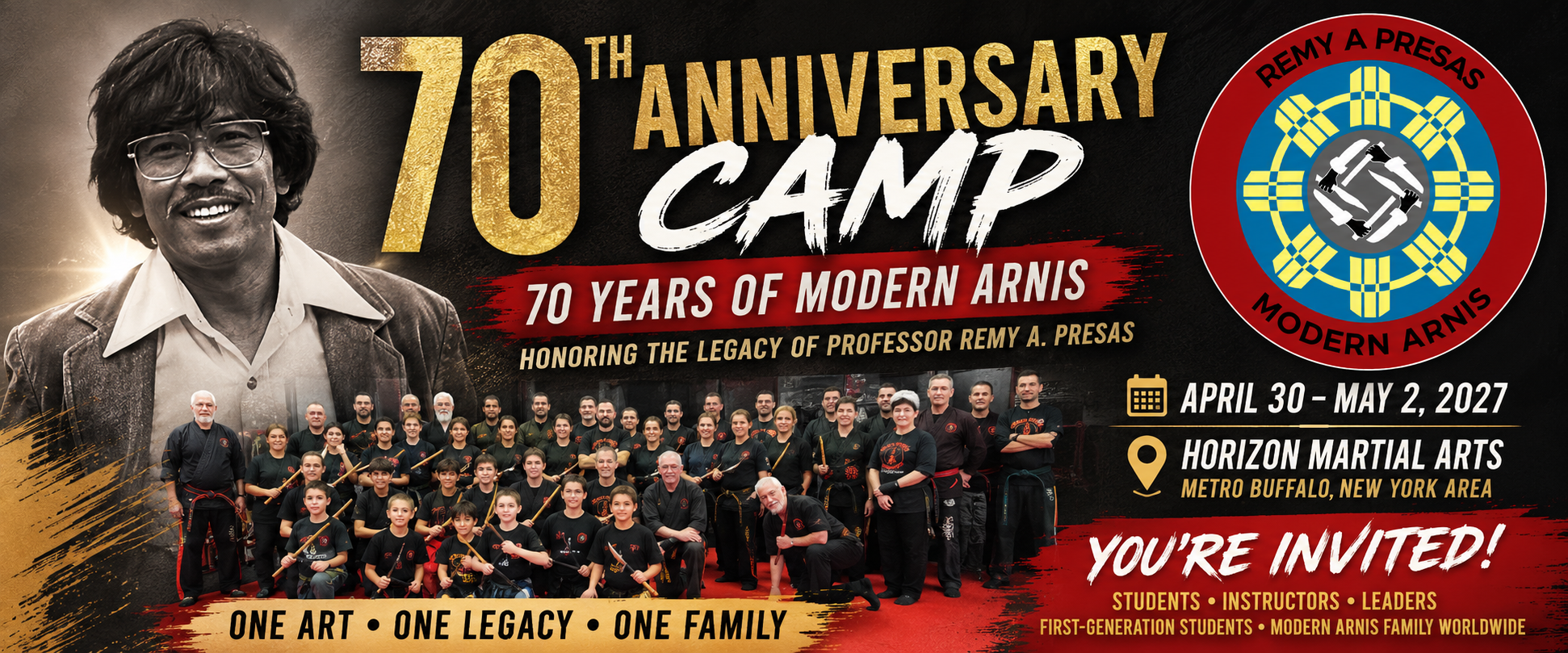
In 2027, we will celebrate 70 years since Professor Presas created Modern Arnis. Seventy-five years of growth. Seventy-five years of friendships. Seventy-five years of changing lives through the art that he shared with the world.
For that reason, I would like to extend an invitation to everyone in the Modern Arnis community.
I invite the students.
I invite the instructors.
I invite the school owners.
I invite the leaders of organizations.
I invite the first-generation students who trained directly under Professor Presas.
I invite those who have remained active and those who have been away for years.
Most of all, I invite those who still carry respect for the art and for the man who created it.
This is not about politics. It is not about organizations. It is not about who is right, who is wrong, or who belongs to whom.
It is about coming together to celebrate the legacy of Professor Presas and the art that has touched so many lives around the world.
We have done this before. The 10-Year Reunion and Memorial Camp brought people together to honor Professor Presas, and many lifelong memories were created. Now, 16 years later, we have another opportunity to make history.
The 70th Anniversary Camp will take place April 30 through May 2, 2027, at Horizon Martial Arts in the Buffalo, New York area.
My hope is simple. I hope to see old friends reconnect. I hope to see new friendships formed. I hope to see different generations of Modern Arnis practitioners sharing the floor together. I hope to see the pioneers, the leaders, and the future of our art standing side by side.
The future of Modern Arnis will not be built through arguments online. It will be built on the training floor. It will be built through shared experiences, mutual respect, and a commitment to passing this art to the next generation.
Whether you are on the path, looking for the path, or searching for a reason to return to the path, I invite you to join us.
Let us celebrate the past.
Let us strengthen the present.
And together, let us help shape the future of Modern Arnis.
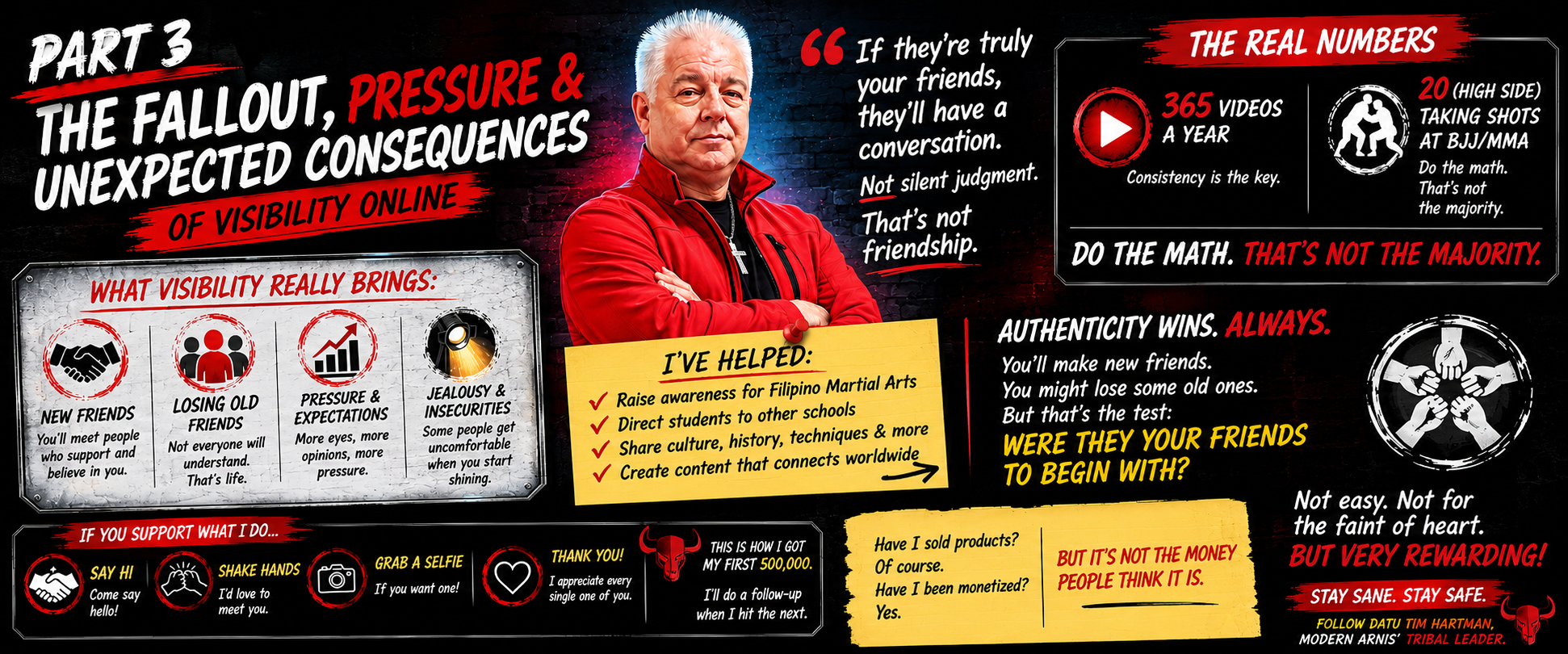
One thing people don’t talk enough about when it comes to social media is the fallout that comes with visibility.
Everybody wants success… until they see what sometimes comes with it.
People ask me all the time if I’m worried about losing friends because of the content I put out.
Honestly? No.
Because real friends have conversations.
They don’t silently judge you over a 30-second clip taken out of context. They don’t gossip behind your back or suddenly distance themselves without ever picking up the phone.
If someone truly has an issue with you, they talk to you.
That’s what real friends do.
But social media teaches you something very quickly:
Some people will applaud your success.
Some people will try to attach themselves to it.
And some people will absolutely become uncomfortable watching you succeed while they aren’t.
That’s reality.
The truth is, people build entire opinions about creators based on one controversial post while ignoring the other 95% of the content being produced.
I put out roughly 365 videos a year.
Even if maybe 20 of them poke fun at BJJ or MMA culture, that’s nowhere near the majority of what I do.
Do the math.
Most of my content is authentic martial arts, Filipino culture, training, humor, motivation, self-defense, and helping bring more awareness to Filipino Martial Arts worldwide.
What’s funny is I’ve had people tell me:
“All you do is bash BJJ.”
Then those SAME people will critique a Filipino history video or another piece of content I made.
And my response is simple:
Thank you for proving my point.
Because that means you ARE watching the rest of my content.
See, controversy sticks in people’s minds more than positivity does.
That’s human nature.
And honestly, when your content starts growing and theirs isn’t, some people get jealous, insecure, resentful, or uncomfortable.
Especially if they tried social media themselves and got an anemic response.
Before social media really took off for me, I’d spend hours writing blog posts that maybe got a couple hundred views.
Now I’ve got content reaching thousands, millions, and one walking cane video approaching 8 million views between Facebook and Instagram.
And ironically, those aren’t even the controversial videos.
That’s authentic martial arts connecting with real people.
Now I’ll also fully admit something else:
My communication style is blunt.
That’s how I was raised. I’m Gen X. We grew up in an era where people got to the point directly instead of carefully filtering every sentence through emotion first.
That doesn’t mean I’m trying to hurt people.
It just means I communicate honestly and directly.
And yes, social media will absolutely test relationships.
Some people you thought were in your corner won’t know how to handle your visibility.
Others will quietly root against you.
And some will surprise you by becoming your biggest supporters.
That’s just part of growth.
But at the end of the day, if someone distances themselves from you without ever having a conversation, you really have to ask yourself:
Were they truly your friend to begin with?
Social media can absolutely be rewarding, but it’s not for the faint of heart.
You need thick skin.
You need authenticity.
And most importantly, you need to separate real life from internet noise.
And honestly, if you ever see me somewhere and you follow my content, don’t hesitate to come say hello.
Seriously.
I’d love the opportunity to shake your hand, take a selfie, and personally thank you for supporting what I do.
Because none of this growth happens without all of you.
So that’s how I got my first 500,000 followers.
I’ll do another follow-up when I hit the next milestone.
Stay sane. Stay safe.
Datu Tim Hartman
Modern Arnis’ Tribal Leader